Understand every Chinese character at a glance
Radicals, usage, SRS, strokes, reading practice — all in one app.



30,000+
Audio Recordings
150,000+
Example Sentences
100,000+
Dictionary Entries
60,000+
Decompositions
Core Modules
Engineered for how characters are actually constructed
Navigate 3,282 characters by radical taxonomy
Query any HSK character and view its radical decomposition, phonetic series, and structural relatives — mapped across the full standard.
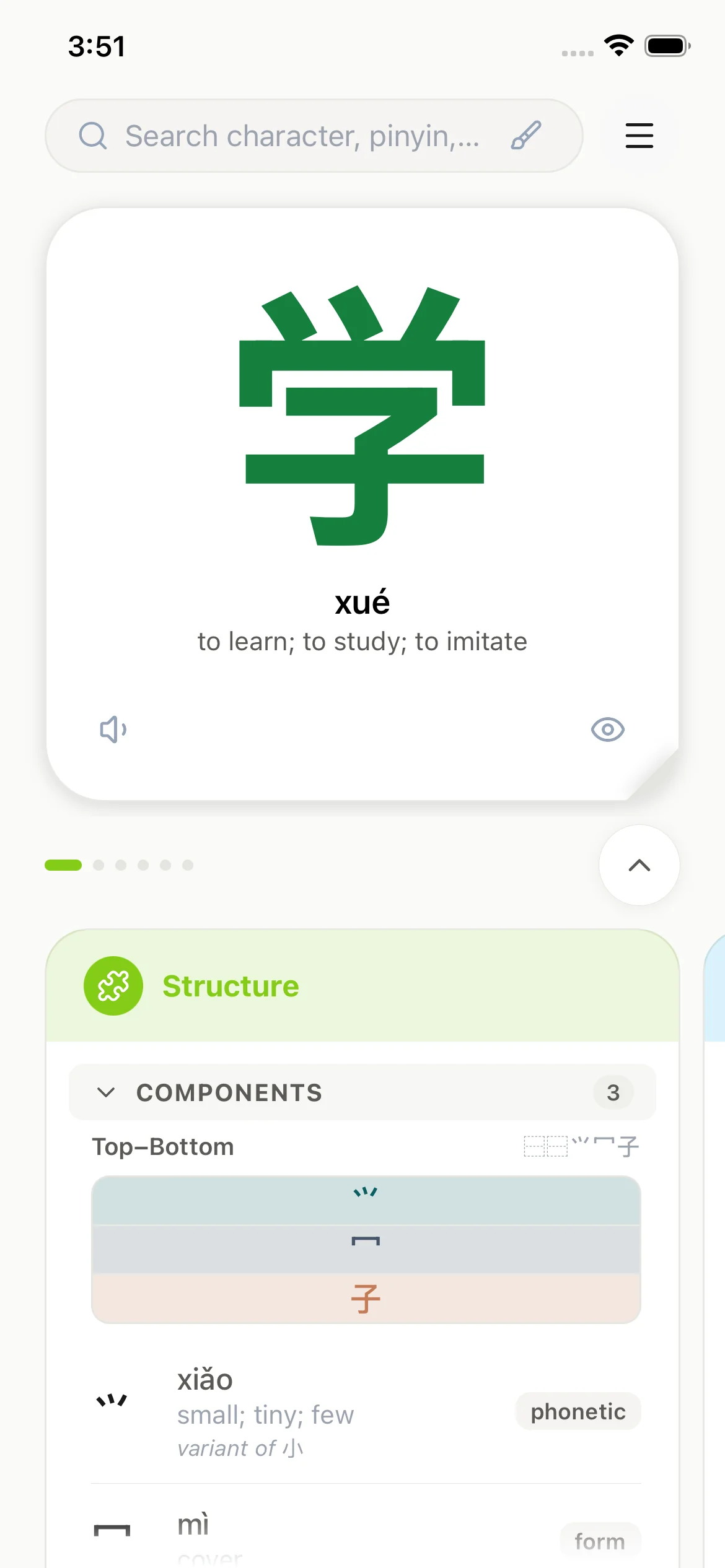
Six data panels per entry
Each character opens a colour-coded carousel — Structure, Words, Usage, Family, Sentences, and Mastery — presenting composition, frequency data, and contextual usage in one view.
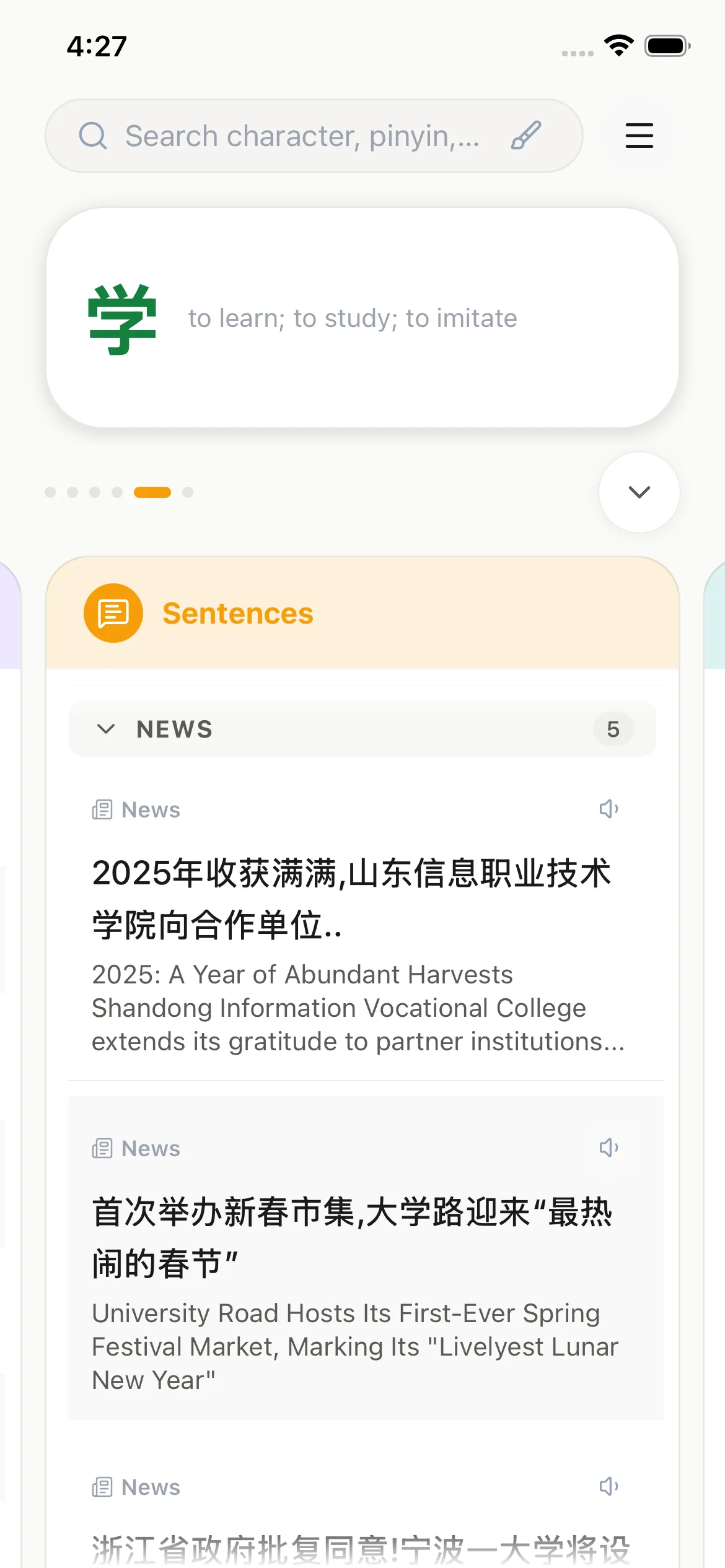
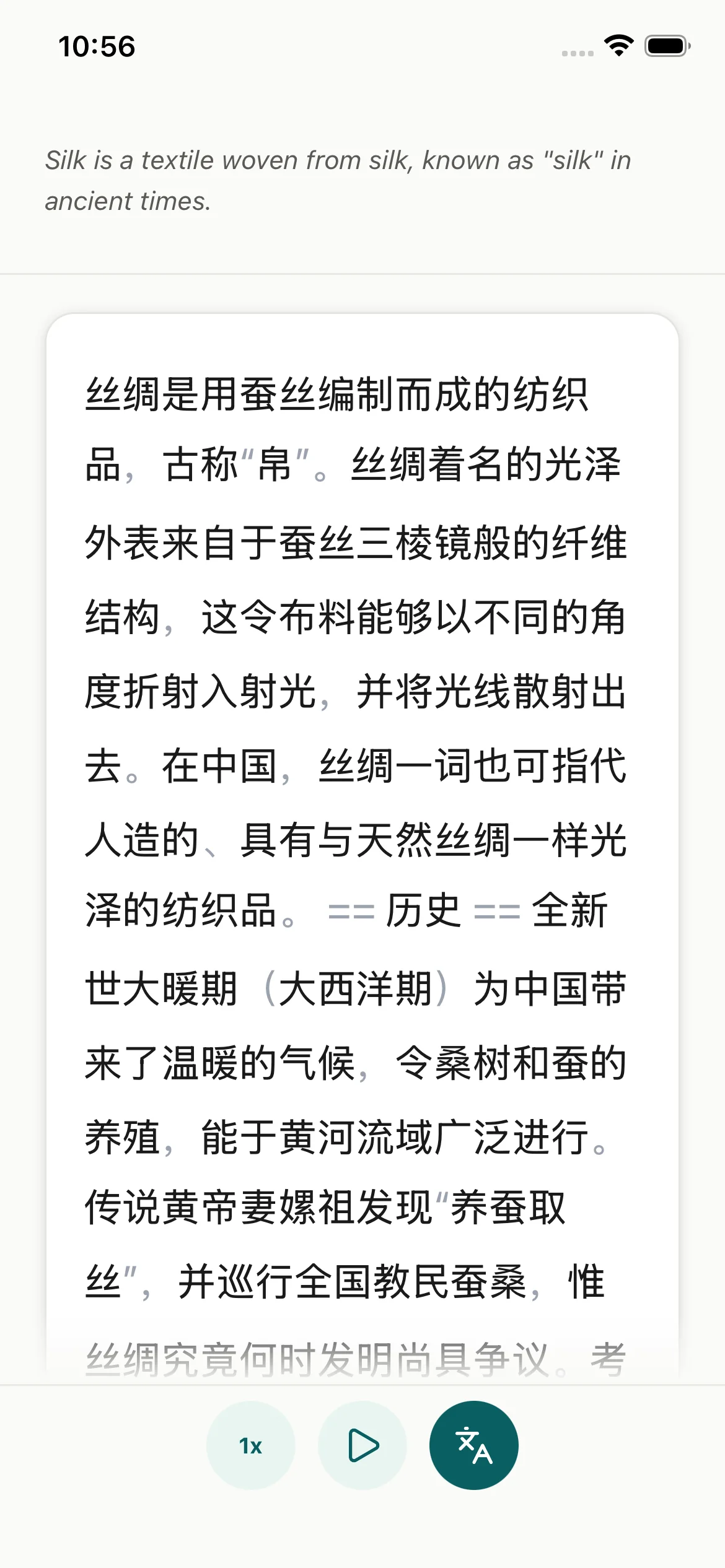
Read real Chinese sentences in context
Practice reading with sourced sentences drawn from news, community content, and curated corpora — each with aligned pinyin and English translations to build comprehension naturally.
Daily: 月
moon; monthAnimated stroke-order playback
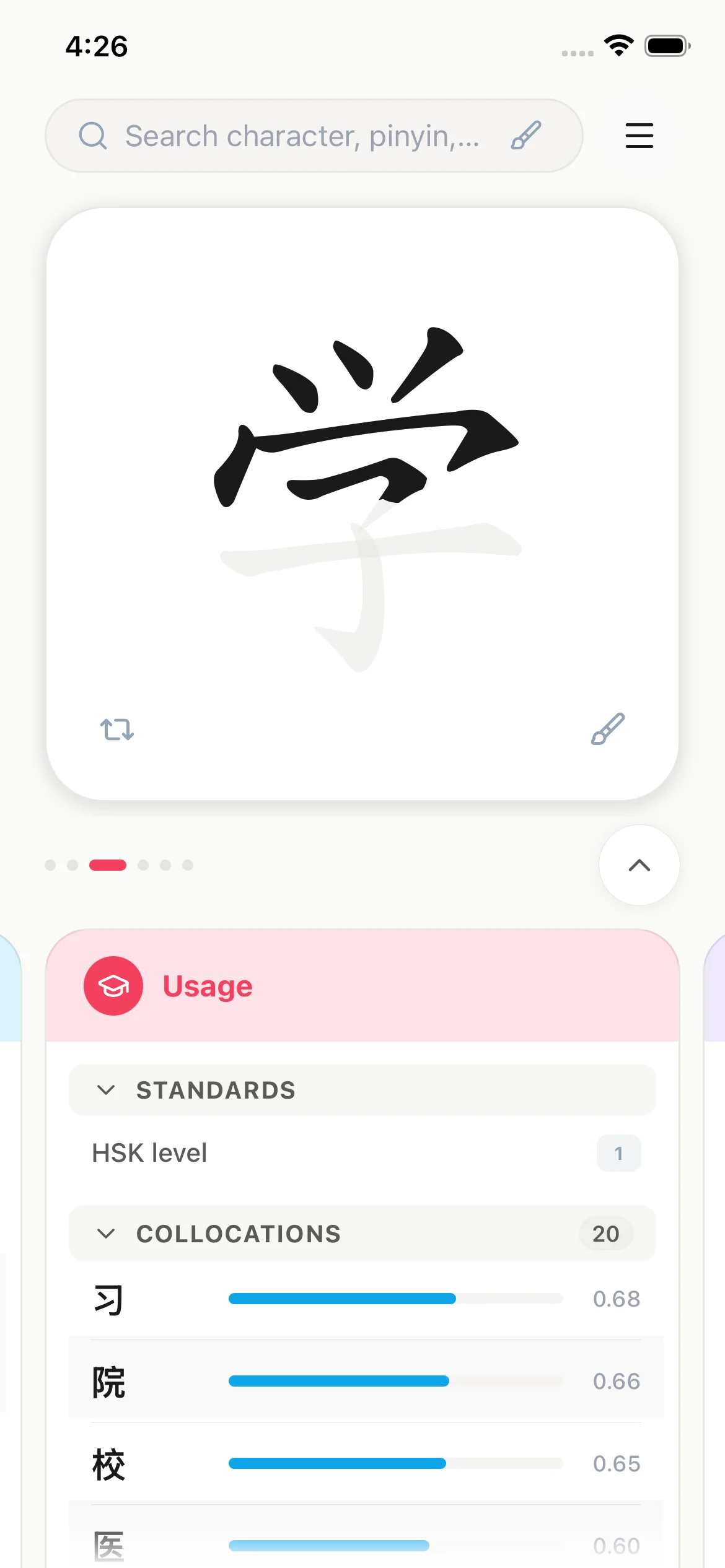
Step through precise stroke sequences for all 3,282 characters on a traditional rice grid (田字格) with frame-by-frame controls.
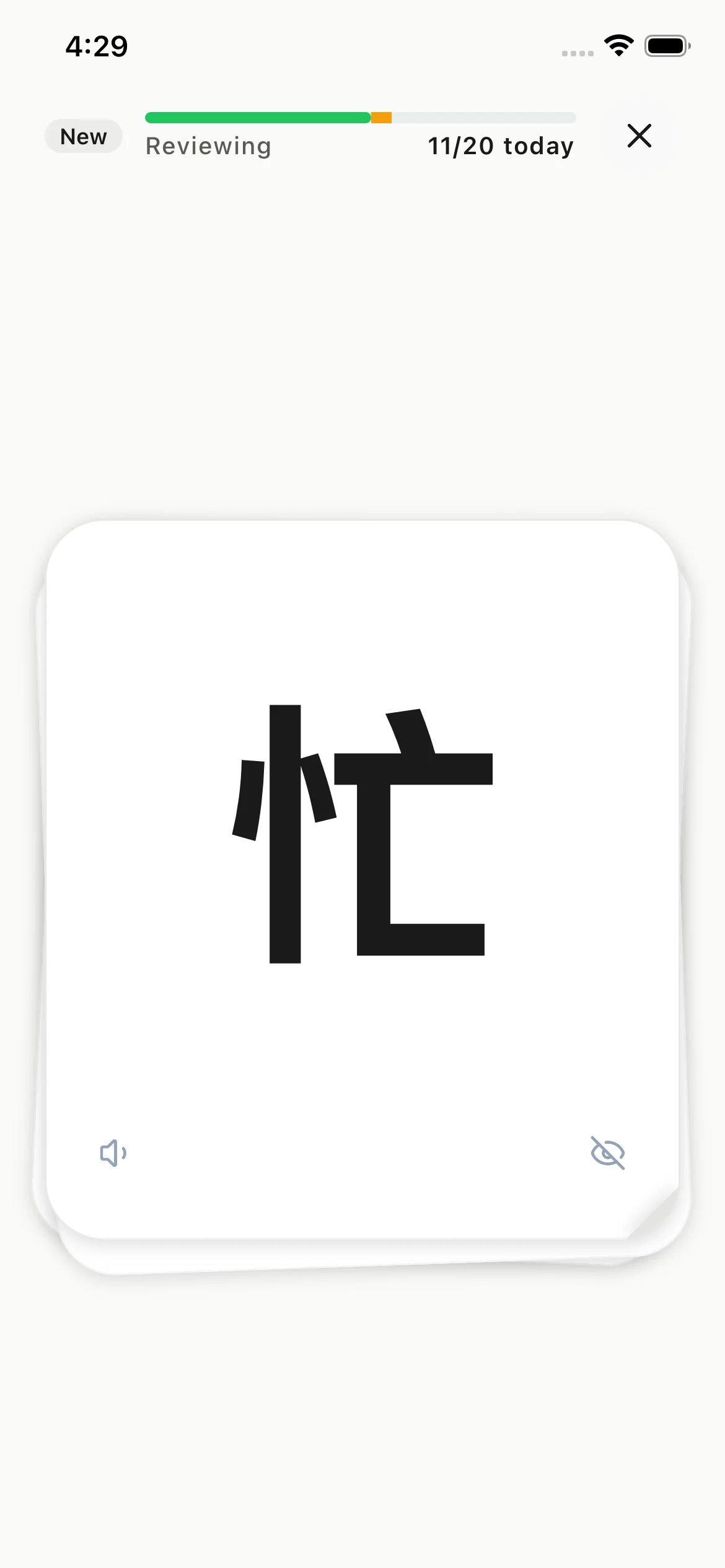
Seven-bucket spaced repetition
A seven-stage scheduling algorithm surfaces characters at optimal intervals. Grade each recall with a swipe — the system recalibrates spacing automatically.
Why HanziFeed
Conventional tools list characters. They don't expose the system behind them.
Chinese characters are not arbitrary — they are composed from a finite set of radicals, phonetic components, and structural patterns.
Conventional Tools
- Isolated character look-ups with no structural context
- Stroke drilling without decomposition data
- Flat word lists with no frequency grading
The HanziFeed Instrument
- Radical-level decomposition and structural mapping
- Six data panels per entry with cross-referenced context
- Frequency-tiered word lists and NPMI-ranked collocations
- Spaced-repetition scheduling calibrated to recall performance
Once the underlying structure is visible, thousands of characters resolve from noise into a navigable system. HanziFeed is engineered around this principle — decompose, analyze, trace, retain, repeat.
Product Features
Under the surface
Four-Voice Audio Engine
30,000+ recordings across four native-sounding voices — character, sentence, and word-level playback.
Sentence Corpus
150,000+ sourced sentences from news, community, and generated corpora — with aligned pinyin and translations.
Script Toggle
Switch between simplified and traditional character forms instantly. Both variants are indexed on every entry.
Tone-Mapped Pinyin
Pinyin is colour-coded by tone across the interface, reinforcing tonal patterns during every interaction.
HSK-Graded Sets
Complete coverage of HSK levels 1 through 7–9. Begin at any tier or construct custom graded sets.
Multi-Axis Search
Query by hanzi, pinyin, English gloss, or radical. Results resolve as you type.
Custom Collections
Assemble character sets by textbook chapter, topic, or personal criteria — fully portable across the app.
Offline Architecture
The complete dataset downloads on first launch. No network dependency — operate on a subway, a flight, anywhere.
Resources
Go deeper with our HSK guide & blog
Free character lists for every HSK level, plus articles on study strategy, app comparisons, and how Chinese characters actually work.
HSK Guide
From the Blog
HanziFeed vs Migaku for Learning Chinese
Migaku turns Netflix and the web into study material. HanziFeed supplies a sequence and a review engine. Which one you need depends on your level.
8 min readHanziFeed vs Mandarin Blueprint: Two Methods
Both are built on character components. One uses an elaborate mnemonic system, the other uses spaced repetition and real text. A fair comparison.
8 min readHanziFeed vs Pimsleur for Learning Chinese
Pimsleur is audio-only and very good at it. HanziFeed is visual and character-first. They solve opposite halves of the same language.
8 min readGet HanziFeed
Available now on iOS and Android.
The core instrument is free — full character browsing, graded sets, spaced repetition, and every study statistic at no cost. Pro lifts the daily reading limit and the five-pack limit, and raises the daily pronunciation-assessment allowance.